Showing posts with label kids/public. Show all posts

Thursday, December 27, 2012

Sunday, February 26, 2012

A sense of scale 2


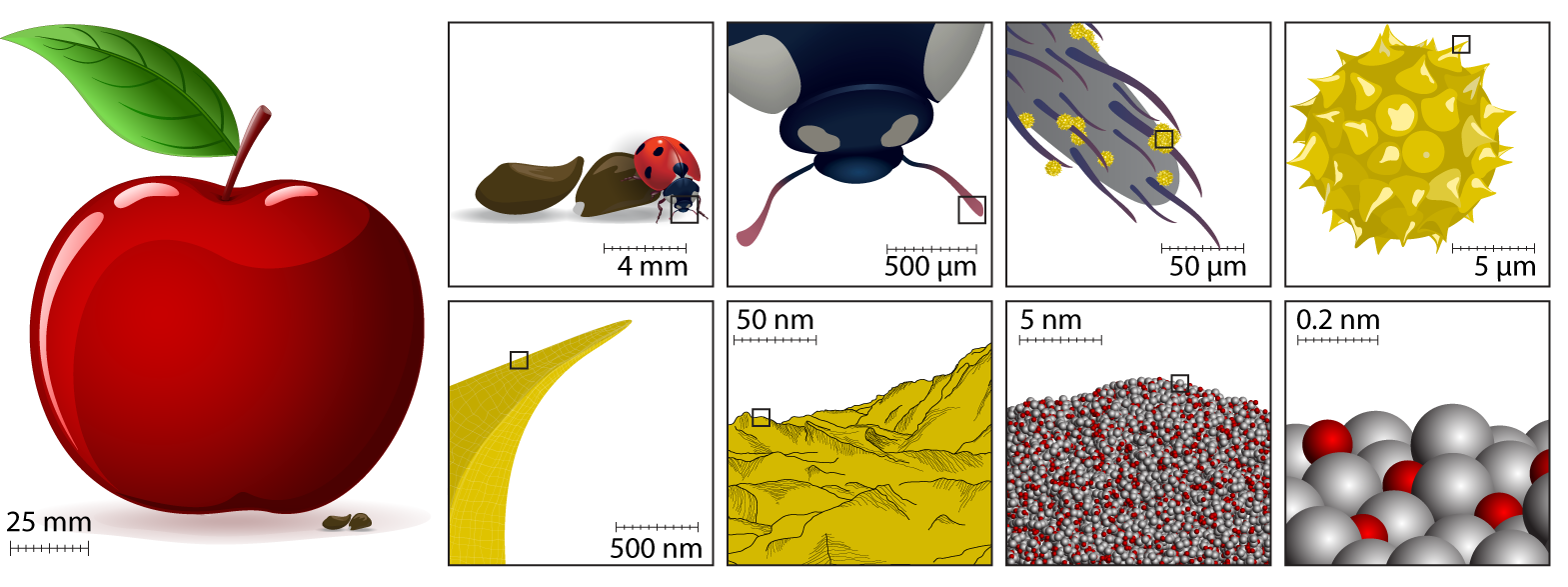
Another great site for getting a sense of scale.  Frankly, shouldn't every chemistry lecture start with a reminder of what scale we are dealing with?

Related blog post
A sense of scale

Sunday, January 8, 2012

The ideal app for an ideal gas


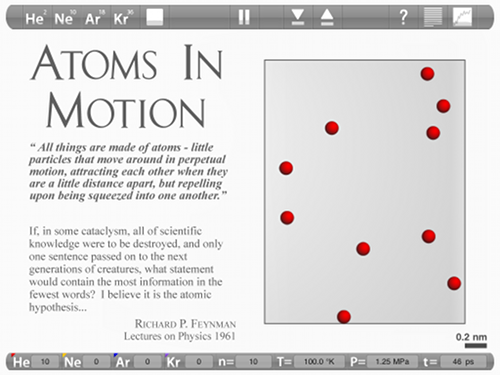
I recently came across a very cool app called Atoms in Motion ($2.99).  With this app you can perform molecular dynamics simulations of He, Ne, Ar, and Kr (and mixtures thereof) at different temperatures, volumes, and number of atoms.


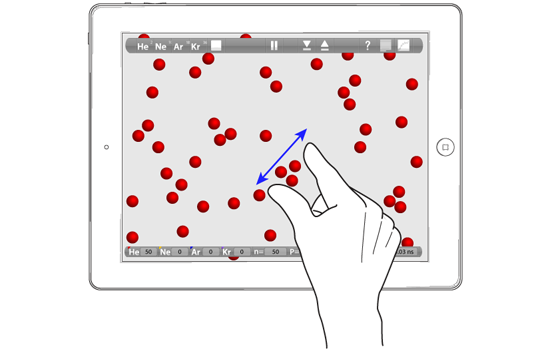
It is effortless to set up a simulation and change the conditions: swipe to change T (or shake the iPad!) and pinch to change V.  You can also flick an atom and, frankly, the most fun is to build a few clusters at 1 K and then move an atom carefully in position and flick it at a cluster! Something I have dubbed "atomic billiards".


Teaching
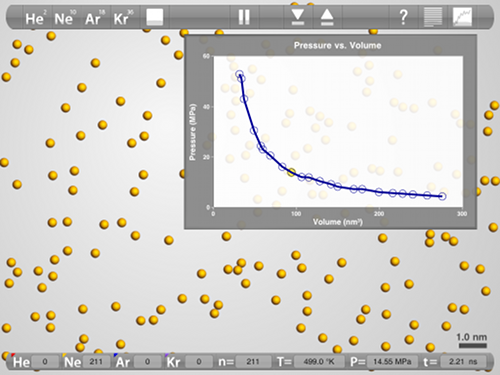
Since not every student has an iPad (yet), the main teaching-use will probably be in lecture, projection the simulation on using a VGA adapter (hint: simulations make for great peer instruction questions).  Because it is based on real simulations, and not pre-recorded movies, the app is very versatile and can be used to demonstrate very simple things like solids, liquids, and gases or an atomic view of temperature or relatively complex things like defects in solids and deviations from ideal gas behavior (using the plotting tool). 

However, the ideal use of this app would really be self-guided discovery.  Most features are very intuitive (the plotting tool takes some practice) and I'd love to see what a class of 10-year olds iPad users would get out of this. Side note: it would really have been great if the iPad could vibrate and the pressure could be linked to the vibration.


Documentation
Another strength of this app is the quality of documentation and extra information available in the app and on the top bar of the website.  I'm particularly impressed by the animated figure on "how big is an atom", which reminded me of the orders-of-ten approach.  I would be lovely to see a similar explanation of the nano-second.

Disclaimer: I was made aware of this app by the developer, but I bought my own copy, and was not asked to write a review on the blog.

Wednesday, June 16, 2010

Fold.it - Solve puzzles for science

I just came across this amazing game/puzzle/software - call it what you will - Foldit.

It's an interactive protein folder that evaluates the energy on the fly to let you know how well you are doing.

But, and here is the important bit, the energy function is the same used in the Rosetta packages - a state-of-the-art protein folder (at least that's how I read it - the details are a bit sketchy). This is not a toy, but an exciting experiment to test whether human intuition and pattern recognition can compete with Monte Carlo sampling.

The screencast below (see a bigger version here) shows 6 intro puzzles that teaches you some of the techniques for protein folding. You get the program here and make an account for yourself here (making an account using Foldit did not work for me).

When you start Foldit the first time it takes you into the intro puzzles immediately (i.e. bypassing the menu).

I don't know where to start about the many implications of this program for fundamental science, teaching, and public outreach. So I'll simply say wow!, and go on to level 2-3. Not a moment to lose, CASP9 is underway you know!


June 20th, 2010 update:

Not sure why I didn't think to check youtube immediately but there are many videos about foldit. Here are a couple:

Saturday, May 29, 2010

The Computational Microscope


A great title and an interesting talk about one of the fundamental roles of molecular modeling.

Wednesday, November 11, 2009

A sense of scale


In chapter 1 of volume 1 of the legendary Feynman Lectures on Physics, Feynman starts by imagining zooming in on a drop of water, past amoeba and so forth, until one can see the water molecules. Starting this way is genius. The tiny length scales and the associated invisibility of atoms and molecules is the single largest barrier to developing a chemical intuition - a barrier that molecular animation can help overcome.

I am often thought of bringing Feynman's imaginary magnification to life by animation, so I as very happy when Nathan Baker brought this site to my attention. The above screencast shows it in action, but the real fun is interacting with it yourself. It's a brilliant piece of interactive animation.

The site brought to mind the granddaddy of them all, Powers of 10, which some kind soul put up on youtube.


Sunday, September 13, 2009

The Computational Chemistry Movie


Last week I presented the Computational Chemistry group to the new graduate students, and made the above movie for the occasion. As I mentioned in previous posts (here and here) I think molecular animation is a powerful but overlooked recruiting tool.

Most of the movie is one long Jmol script, but it took some post-editing of the resulting recording to smooth the transitions, i.e. remove the lag time when Jmol is computing the surfaces. The coordinates of the reaction and the large nanostructure is taken from Chemtube3D and this site, respectively. I have described how to extract the coordinates from a site using Jmol in a previous post. The orbitals and vibrational modes were computed using GAMESS and RHF/STO-3G.

The molecular dynamics animation towards the end is done with Molecular Workbench. You can find the simulation here, but you need to install Molecular Workbench to see it.

The equation animation and final credits are done with Powerpoint.

I hope you find the movie entertaining and useful, and feel free to use it (i.e. link to it, embed it, use in a Powerpoint presentation, etc.) if you do. Here is the page in blip.com where you can find the link and the source file in .mov and .flv formats.

Thursday, July 2, 2009

You know, for kids!

Oxygen from Christopher Hendryx on Vimeo.

Much of this blog is about making chemistry more accessible through animation. While animation helps greatly in teaching at the college level, it is absolutely crucial when trying to connect with the general public. Creating such animations is also much more difficult since it has to be entertaining in addition to being informative.

So hats off to Christopher Hendrix for doing just that. This movie is a great service to chemistry. Now it's up to us to help bringing it to the attention of as many people as possible. Take a minute to think about a web page, family member, facebook friend, congressman who could benefit from a link to this movie ... good! Now, why not send them an email?